Born in a garage, made on the track: the making of F1 leader Kimi Antonelli
Born in a garage, made on the track
Kimi Antonelli was 10 when his father Marco first realised the boy sitting on his lap, operating the steering and gears, might have an exceptional talent as a racing driver. Now a 19-year-old dominating this year's Formula 1 championship in only his second season, Antonelli's story begins, his father says, with a boy who was "born in a garage".
The pair were at the Adria circuit in north-east Italy, Marco with his Lamborghini sports car team, Kimi competing in a karting race. It was the end of the day and Marco, a former driver himself, asked his son: "Do you want to try the Lamborghini?" Dad was in charge of the throttle and brake; his son would control the rest.
"I couldn't see the track because he was in front of me with a helmet on," Marco tells BBC Sport. "I could only see beside me the marker panels before each corner - 100m, 50m."
"We started to drive, step by step, faster, faster, faster. In the end, I pushed like I was alone and I arrived at the braking point at the end of the straight, 320km/h, braked very hard and at the limit. The car had a lot of oversteer. Kimi controlled the oversteer perfectly, then I went on the throttle, Kimi finished the oversteer, changed gear, and went. I said: 'OK, stop, because it has now become dangerous.' But when I saw the video, 10 years old, on my leg, oversteer, everything perfect, I said: 'Maybe he has something special.'"
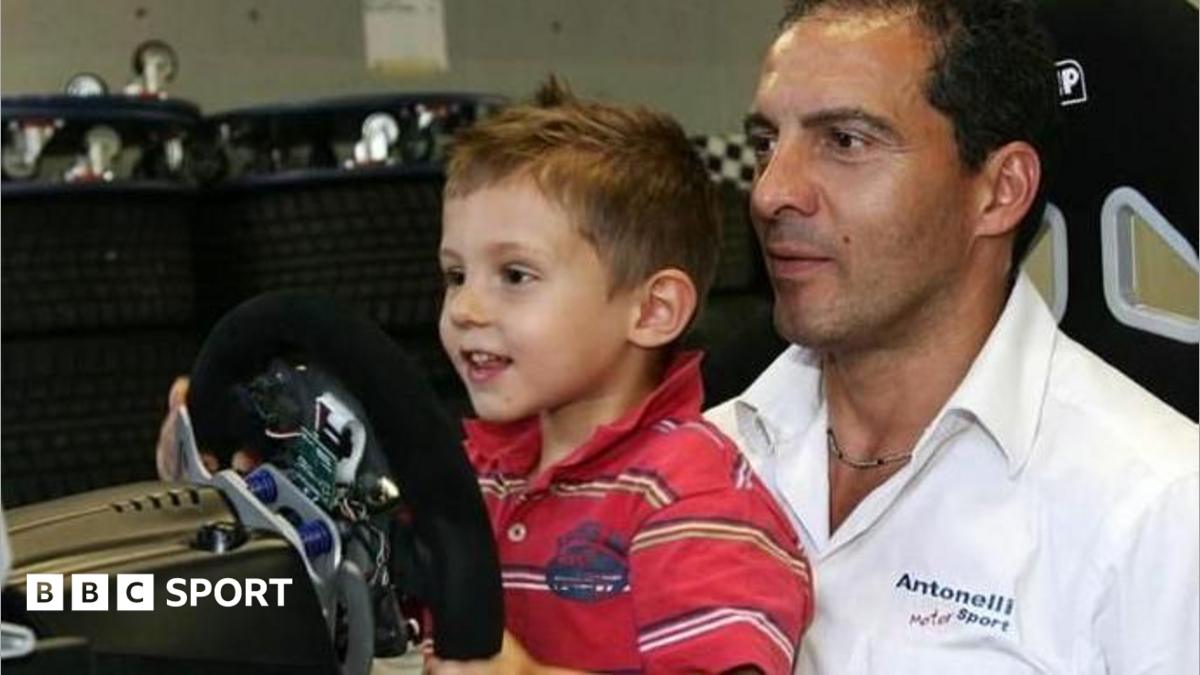
A passion that worried dad
Kimi Antonelli used to enjoy playing on a motor racing simulator. "Kimi from 15 days old was in the garage and heard the sound of the engine and the smell of the exhaust," says Marco, who worked with his wife Veronica on their racing team business. It was the Christmas holidays when Kimi was about three, and Marco had brought home a simulator he had bought for his guests to try out at the Bologna Motor Show. "Each evening, Kimi wanted to drive," Marco remembers.
"I remember one night I started to fall asleep because I had been at work very early and we had a crash because I didn't brake when we arrived at the end of the straight. And Kimi said: 'Dad, dad, no sleep, no sleep. I have to drive.'"
Marco Antonelli did not originally want his son to become a racing driver, because of his own struggles during his career. "Sometimes you are fast but not in the right position to become a professional driver," he says. In the 1990s, Marco was on the cusp of becoming a works driver in the DTM touring car series, testing for Alfa Romeo before the opportunity evaporated. Another chance came up with BMW, alongside Roberto Ravaglia and Steve Soper - stars at the time. Again, the same thing happened.
"I suffered a lot for it. And, of course, I was scared that my son [would] relive the same situation. At the beginning, I was very stressed about the passion my son had for motorsport."
Mercedes comes calling
Kimi tried a go-kart for the first time when he was five, and immediately showed an awareness of racing lines, braking points and car control. The Antonellis were what Marco describes as "a normal family". They could not possibly afford to pay for Kimi to take part in all the categories on the way to Formula 1; Marco figured he could fund karting and a year of Formula 4 before putting him in one of his GT cars. But Kimi immediately started to impress - whatever category he got into, he was quick, and won.
By the time Kimi was 11, his name was buzzing around motor racing circles. Mercedes heard about him, and their driver academy scout Gwen Lagrue flew to Italy to check him out. It was a season in which Antonelli had ended up driving a kart with less power than those of his rivals. "Gwen was impressed about this condition of power and driving in this category that Kimi did," Marco says. "And maybe they understood that Kimi was a different child."
Now a member of the Mercedes driver academy, Kimi could stop worrying about money and focus on his potential. Mercedes were not the only big names in F1 who had noticed his promise. "When he was in karting, you could already see he was one of the stand-out talents," says four-time world champion Max Verstappen, the only other teenager to win an F1 race.
At 15, Antonelli moved up to cars, and through 2022 he swept the board in various championships in Formula 4, repeating the trick in Formula Regional in 2023.
The phone call that changed everything
By now, Mercedes team boss Toto Wolff was already thinking Antonelli would be his next F1 driver, potentially a replacement for Lewis Hamilton. When it came time to negotiate a new contract with Hamilton in 2023, Wolff played hardball - Hamilton wanted two firm years, Wolff only one. They compromised on a contract for 2024 with an option for 2025. Hamilton, unimpressed, signed to join Ferrari in 2025, telling Wolff in late January 2024.
Wolff immediately phoned Marco Antonelli with the "very big news". "'We put Kimi in Formula 1,'" Marco remembers Wolff saying. "'What do you think?' I said: 'Oh, [it] is a difficult question you ask me. Of course I'm happy that you think about Kimi but are you sure he's ready?'"
Antonelli had not even driven an F1 car when Wolff made the call. Mercedes put together a testing programme of 20-odd days in cars a couple of years old at tracks all over the world. "It was how rapidly he would get up to speed," says trackside engineering director Andrew Shovlin. "What you normally see with drivers is they're just incrementally going a little bit quicker, braking a bit later. If you compare with other drivers we've seen in an F1 car for the first time, the best I'd ever seen until then was George [Russell]. You suddenly saw someone who was quite similar." With Kimi, Shovlin adds, it took just a couple of runs to work out how the car behaved before he was more or less on the limit.
Now, at 19, with Antonelli dominating the championship and on course to become F1's youngest-ever world champion, the faith Mercedes placed in a boy "born in a garage" appears to be paying off.