Maharashtra drought deepens as 17-week rain shortfall hits Marathwada and Vidarbha
Persistent monsoon failure creates drought-like conditions across Maharashtra
Pune: Maharashtra’s drought isn’t the result of one dry spell — it’s the cumulative effect of a faltering monsoon, week after week, since June. An analysis by the India Meteorological Department shows the state has now logged a rainfall deficit of 18%.
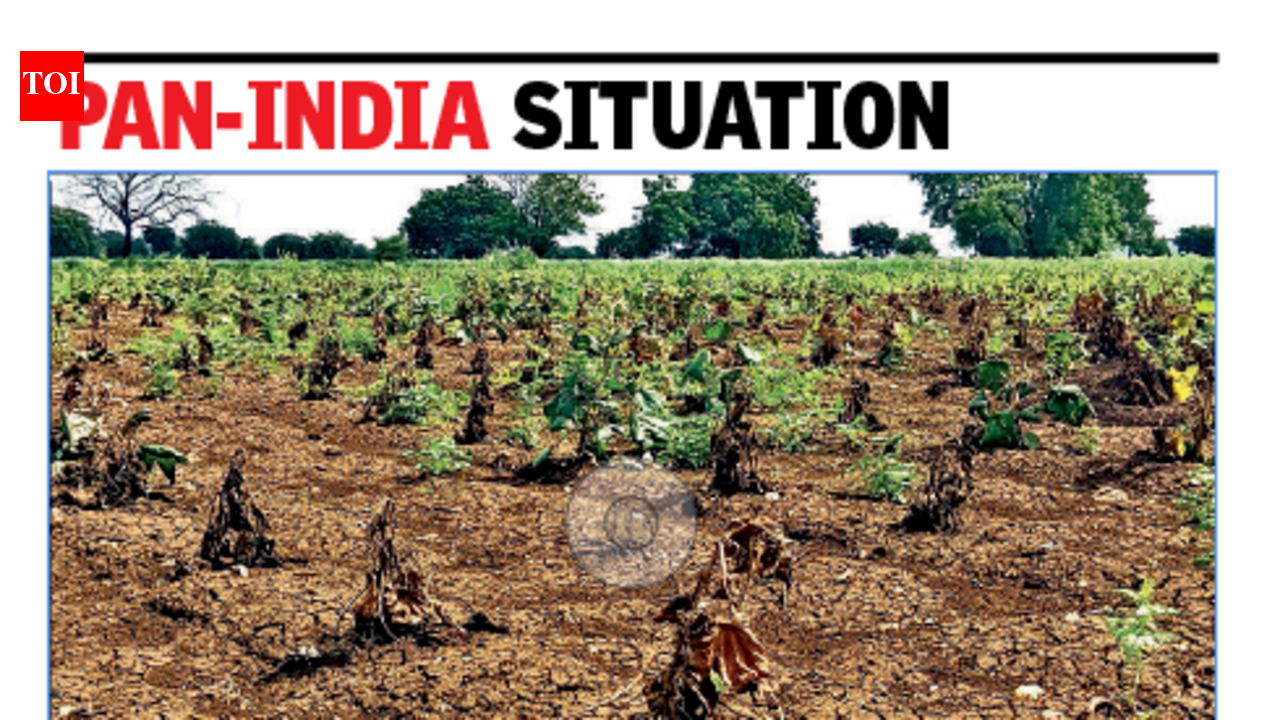
As of Sept 25, Maharashtra received 798.2 mm of rain against a normal of 970.9 mm. The shortfall was concentrated overwhelmingly in two regions — Marathwada and Vidarbha. Marathwada’s deficit stood at 38% and Vidarbha’s at 23%.
17 weeks of persistent deficiency
Satyaban Bishoyi Ratna, head of climate application and user interface at IMD Pune, said the pattern behind those numbers made this drought different from a typical bad monsoon year.
"Of the 17 weeks tracked so far, Marathwada recorded deficient to large-deficient rainfall in 12 of them, and Vidarbha in 11. Marathwada has stayed continuously deficient to large-deficient from mid-Aug onward. Vidarbha has followed almost the same trajectory, broken only by a single week of excess rain in Sept," Ratna said.
"From the rainfall perspective, we can clearly see a drought-like condition. But the ground situation can sometimes be different. If irrigation facilities are available, there may not necessarily be a real drought in every area. From the rainfall perspective, there has been a strong and large deficiency in rainfall so far, and that is why we are seeing this drought-like condition," he said.
Ratna said the week-by-week data shows a long persistence of deficient and large-deficient rainfall. That has driven the seasonal shortfall — not one isolated failure, but a steady accumulation of shortfalls over the season.
Uneven impact within worst-hit regions
The picture has been far from uniform even within the worst-hit regions. In Marathwada, the deficit ranges from 33% in Nanded to 45% in Dharashiv. In Vidarbha, it spans from 39% in Amravati to 28% in Chandrapur.
Elsewhere in the state, the contrast is starker. Pune recorded an 18% rainfall surplus and Nashik a 37% surplus over the same June 1–Sept 25 period.
Hill talukas added to drought list
Mahabaleshwar, which made headlines in July after recording 473 mm and 406 mm of rainfall on two consecutive days, has found a place on Maharashtra’s Drought Trigger-1 list. Along with Mahabaleshwar, several traditionally high-rainfall talukas in Satara and Kolhapur districts, including Khandala, Panhala, Radhanagari, Ajara and Gaganbawda, have been included in the drought-affected list because of rainfall deficiency.
The inclusion of these hilly and high-rainfall areas highlights the impact of prolonged gaps between rainy days despite intense spells of rainfall. The uneven distribution of rainfall has affected agricultural activities and left farmers vulnerable, although several dams in the region have reached full storage capacity. Paddy cultivation, carried out extensively across these hilly talukas, is expected to be particularly affected.
Kolhapur district recorded an overall rainfall deficit of 49% during the monsoon season. Among the talukas included in the Drought Trigger-1 list, Panhala recorded a 34% deficit, Radhanagari 61%, Ajara 45%, Chandgad 61%, Bhudargad 33% and Gaganbawda 40% between June 1 and Sept 25. These talukas in the district’s hilly region generally receive rainfall on almost every day during the monsoon. Several areas record over 50 mm of precipitation on rainy days. Nearly 80% of Kolhapur’s dams are also located in these talukas.
Satara district recorded an overall rainfall deficit of nearly 20%. Mahabaleshwar recorded a 34% deficit, while Phaltan recorded 33%, Satara 32%, Man 56% and Khatav 22% during the period. Interestingly, Khandala taluka has also been included in the drought list despite receiving 20% excess rainfall this year.
Why seasonal totals can mislead
Ratna said the pattern highlighted why a seasonal rainfall figure alone might not capture the full impact of a weak monsoon.
"Repeated deficient weeks, particularly during crop-sensitive periods, can steadily reduce the water availability even when isolated spells of heavy rain occur elsewhere in the state," he said.
IMD data also showed that Maharashtra was among the worst-affected states so far in terms of rainfall deficiency.