Vance's 'foreign indentured servants' swipe at Microsoft ignites backlash over his own family's immigrant roots
Vance's 'foreign indentured servants' swipe at Microsoft ignites backlash over his own family's immigrant roots
WASHINGTON — US Vice President JD Vance set out to put Silicon Valley in the dock. Instead, he opened several lines of fire at once.
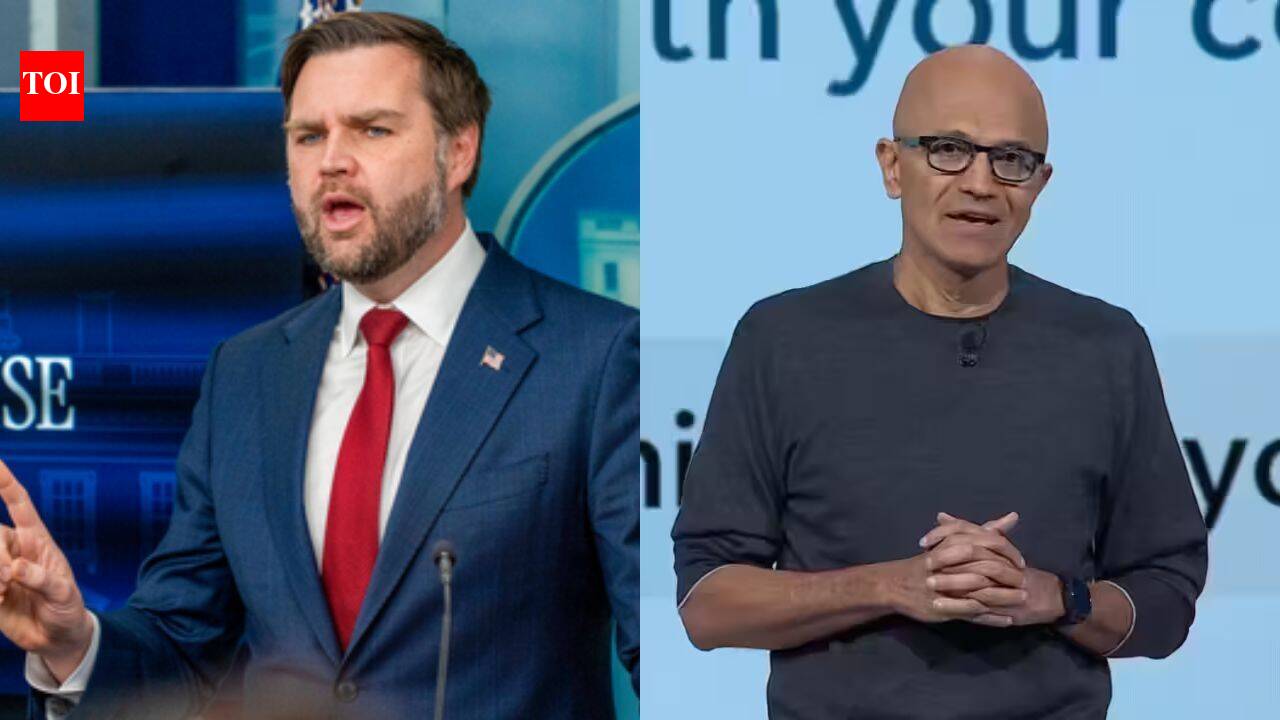
Vance accused Microsoft of replacing American workers with what he called “foreign indentured servants” — a colonial-era turn of phrase that invited a withering response from New Delhi — and did so shortly before his boss honored the company's India-born CEO, Satya Nadella, at the White House.
The blowback was swift and came from multiple directions: from Indian professionals who regard H-1B visas as a route to opportunity rather than servitude; from tech giants who credit immigrants with building some of America's most valuable businesses; and from social-media users who delighted in surfacing an immigration controversy in the vice-president's own family, amplified by a rabid section of the MAGA base.
The family-history barb boomerangs
Among the barbs ricocheting around social media was the claim that “His in-laws were indentured servants and his wife is an anchor baby.” The reference to Vance's in-laws was pointed, if imprecise.
His wife, Usha Vance, was born in California in 1986 to Krish and Lakshmi Chilukuri, immigrants from Andhra Pradesh. The family settled in the San Diego area, where her father pursued an engineering career and her mother became a molecular biologist. Usha Chilukuri went on to Yale — an institution founded with a donation from Elihu Yale, the Bostonian who pillaged India as governor general of Madras — and met JD Vance at Yale Law School.
In other words, the family's publicly documented story is one of immigration, higher education and professional achievement. There is no established evidence that her parents were “indentured labourers,” since their coming to America predated the H-1B program that began in 1990 — though their route to US residency, from academia to employment, was not dissimilar. Calling Usha an “anchor baby” is equally misleading; she was born in California and is a US citizen by birth under the constitutional rule generally applicable to people born on American soil.
Microsoft hits back with the numbers
Microsoft's response directly challenges the impression that its H-1B figures represent thousands of new foreign hires. Of approximately 6,000 H-1B applications it filed in the last fiscal year, the company said, 80% were extensions or changes of status for existing employees — not applications to bring in new workers. The remaining filings concerned people already legally present in the US who chose to work for Microsoft; the company said these employees amounted to about 1% of its US workforce.
Microsoft also said it pays H-1B employees the same as other employees doing comparable work, and that its wages rank among the highest in the technology sector. While the figures do not establish that Microsoft never displaces American workers, or that every H-1B employer complies with the law, they do challenge the simple Vance arithmetic in which 6,000 layoffs plus 6,000 visa applications automatically equal 6,000 replacements of American workers deserving “American jobs.”
The CEO Vance's boss just honored
There is another inconvenient detail for Vance's argument: Nadella himself immigrated from India and built his career in the US, becoming Microsoft's CEO — only the third after Bill Gates and Steve Ballmer — in 2014 after joining the company in 1992. While a career is hardly proof that every visa holder is indispensable, it is a reminder that the immigrant talent pool Vance is attacking has also helped produce the very American corporate success he wants to defend.
Microsoft has grown more than 12x — market cap climbing from $300 billion to almost $4 trillion — during Nadella's tenure, and many American retirement accounts have grown on the ballast provided by such tech giants.
“Good luck building companies without these 'indentured servants'”
Among the most pointed responses came from Shobhit Mathur, co-founder and vice chancellor of Rishihood University and an IIT alumnus. Recalling his early days at Amazon in an H-1B role, Mathur wrote on X that he was part of the initial team that built Amazon Web Services (AWS), which he described as now contributing more than 60% of Amazon's profits.
His post's central argument was simple: around a hundred H-1B holders were part of that early team, and the company's subsequent transformation would have looked very different without them. “Good luck building companies and wealth without these 'indentured servants',” he scoffed.
Why escalate now?
The timing of Vance's broadside has prompted another question: why is the administration escalating its campaign now, rather than earlier in Trump's term — or, for that matter, during his first term? The answer may be a mixture of policy and politics.
The administration has already taken steps to tighten the H-1B program, which even some supporters say had been gamed by some operators, and the latest action gives Vance an opportunity to demonstrate that the crackdown is reaching powerful corporations, not just migrants at the bottom of the labour market. Naming Microsoft and suspending its access to a green-card process creates a visible target — although Vance and company have conspicuously let Amazon, which processes more H-1Bs than Microsoft, off the hook.
The final twist of irony
The final twist came in the early hours of Friday, even as Vance's gibe about “indentured servants” echoed across the world — where several nations are led by descendants of immigrant labourers. The Nobel committee awarded the 2026 peace prize to Navi Pillay, the South African jurist of Indian Tamil descent, snubbing a non-indentured leader who has, in the article's words, “literally been begging for it.”