Sanat Sangwan named in North Zone squad for Duleep Trophy after breakout 828-run Ranji season
Delhi's Sanat Sangwan earns North Zone call-up after breakthrough Ranji campaign
NEW DELHI: Sanat Sangwan is not one for fuss. The 25-year-old Delhi southpaw, whose cover drives lack the elegance of fellow left-handers but whose temperament at the crease is now the envy of a fragile batting line-up, has been named in the North Zone squad for the Duleep Trophy, which gets under way on Sunday (August 23) at the BCCI's Centre of Excellence in Bengaluru.
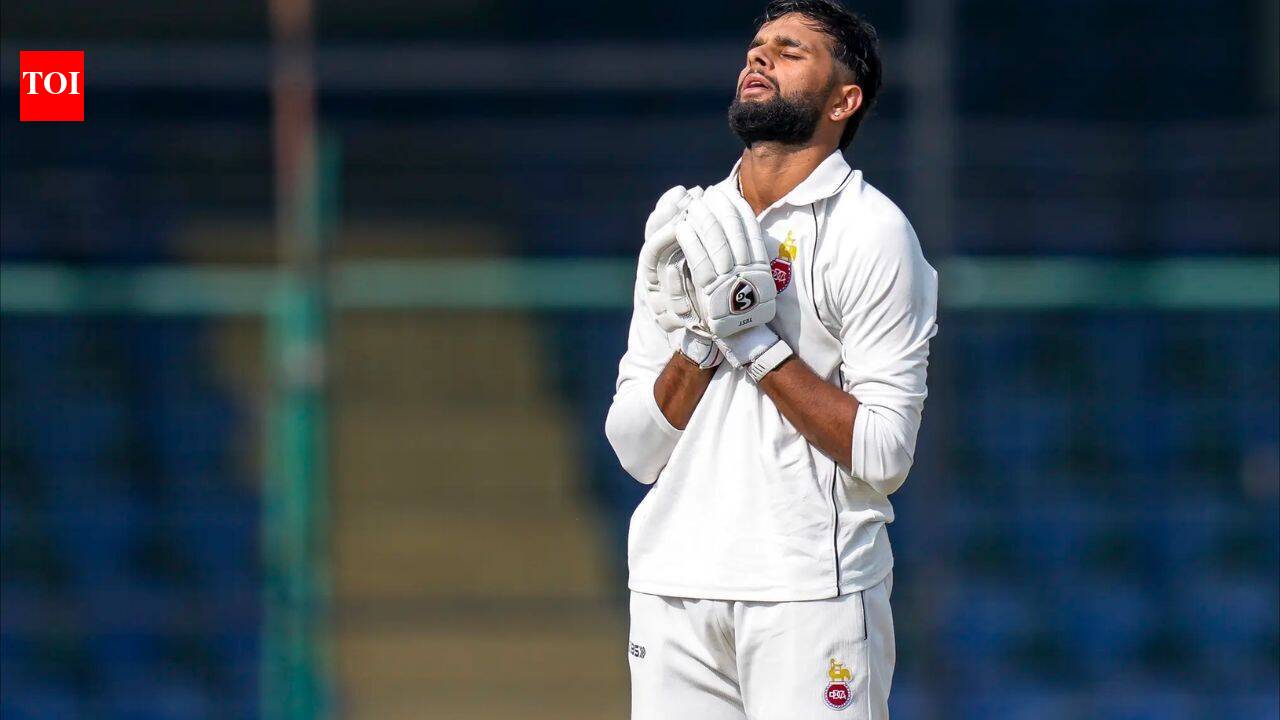
The call-up caps a remarkable turnaround for a batter who managed just 385 runs in his debut Ranji Trophy season of 2024-25. Sangwan could not convert his starts then, but in the 2025-26 season he roared back with 828 runs at an average of 69, including three centuries. The hard work behind those runs, he says, was built in the off-season.
"Red-ball cricket is my favourite format"
Sangwan explained the graft that has made him Delhi's most consistent batter over the last two domestic seasons, speaking at a media interaction organised by Delhi Premier League franchise South Delhi Superstarz.
"You have to put a lot of effort into preparing for red-ball cricket during the off-season. Conditions are different, and as an opener, it is always difficult while facing the new ball. And sometimes you might have to walk out to bat in the afternoon or sometimes even when the lights are not good. So keeping all things in mind, I prepare more for red-ball cricket during the off-season," he said.
He details a regime built around discomfort. "I prefer to go to the nets at around 8 am when there is a little moisture on the wicket. I try to replicate the conditions that I get in matches. I practise a little earlier because the more I practise in difficult conditions, the easier it becomes to adapt. I ask the net bowlers to start with a new ball. Then, after an hour, I give them another new ball. I try to face more new balls in the nets so that the situation doesn't feel easy for me in a match."
On his affection for the longest format, Sangwan is unambiguous: "I love this format. From the start, you see the opener go out to bat with the new ball. Then the conditions get better, and then the second new ball comes again. There is a lot in this format. It is a difficult format. It tests your skill, patience and fitness. The result is not in your hands. You can come back at any time. If you take two or three wickets quickly, or have a good partnership with the bat, you can change the game. I have worked a lot on my cricket since I was 19. Red-ball cricket is my favourite format."
"Tire the bowlers in the first hour"
Not the prettiest strokemaker, Sangwan instead prides himself on a watertight method. "In red-ball cricket, I try to select my shots according to what I have prepared. I don't play the cover drive early in my innings. I try to avoid cutting the ball as much as I can. I don't play away from my body. The more you play away from your body early on, the chances of getting out increase. If you stay closer to the ball, then the chances of getting out are lower. The bowler also gets frustrated. It is a game of patience. If you take five or seven overs, the bowler also tries to bowl a little fuller. Then a big over can come and scoring runs becomes easy. So I try the bowlers in the first hour and then pounce on it once I am set."
Mental conditioning is central to that approach. "I have a very strong base, so I have done a lot of work on that. I improvise a little in white-ball cricket, but I avoid doing that in red-ball cricket. I have gained so much control through practice. I practise every day. I practise red-ball cricket day to day, so I have gained enough control to try to control myself for the first two hours. I also work on meditation so that I can focus and get mentally better."
Having fallen for 99 last season, Sangwan has learnt to tame the rush of the 90s. "There was only one innings last season when I got out on 99. If you look at any of my centuries, I complete them with boundaries. In the 90s, I have this rush to get to 100 quickly. So I have made sure that I don't lose control. I will play the same way in the 90s as I played to get there. If I can control that a little, that is a learning from the last season. Now I have decided. I don't want to see the scoreboard."
Breathing, too, has become a tool. "I keep meditating because it works across all three formats. In T20 cricket, you have to control your breathing. The more you control it, the calmer you will be. There are a lot of situations where there is pressure. The calmer you are, the better you will be able to handle the situation. It plays a big role mentally."
Kohli and Hamilton effect
Virat Kohli and Lewis Hamilton have left a deep imprint on Sangwan's sporting life. A tattoo on his left hand reading "Still I Rise" is inspired by the Formula 1 driver, while in his debut season he was gifted a bat by Kohli, who turned out for Delhi in the Ranji Trophy.
"I have followed Lewis Hamilton since he was with Mercedes. I have admired him from the start. His mindset, from what I have seen in interviews, is very focused. He is very patient, and he does things like meditation," Sangwan said.
Of Kohli, his eyes light up. "I idealise him from the start. How he had helped India win Test matches. His aggression on the ground. I had a different picture of Virat Kohli in my mind and when I met him, when he came for the Ranji Trophy, he was completely different. On the field, you can sense the intensity but off the ground, he was so chill, humble. But after watching his work ethics, we were very stunned."
The next challenge
Having starred in the DPL with a scintillating century over the past fortnight, Sangwan's immediate goal is to transfer that red-hot touch into the Duleep Trophy and chase a 1,000-run Ranji season. "I believe you need to have a different mindset to succeed in all three formats. Skill-wise, if your base is strong, then you can comfortably switch your game as per the formats. I am playing DPL now but I also had in mind that if I get a name in Duleep Trophy, then I will have to do red-ball preparation as well. So I have been doing that side by side."
For now, his focus is simple: take the lessons of a breakthrough Ranji season into the Duleep Trophy, trust his method and let the runs do the talking. With a clear understanding of his game and a growing appetite for red-ball cricket, the opener sees the tournament as proof that last season was not a one-off, but the beginning of something bigger.