Baku demands downforce compromise and bold strategy as F1 returns to the Caspian Sea
The Risk Perspective on Baku
Formula 1 first came to Baku a decade ago with eyes wide at the prospect of the mammoth main straight, the narrows of Turn 8, and the novelty of racing below sea-level. A decade on, the Azerbaijan Grand Prix is less about spectacle and more about frantic qualifying action, the caprices of Safety Cars and bravery on the brakes into Turn 1.
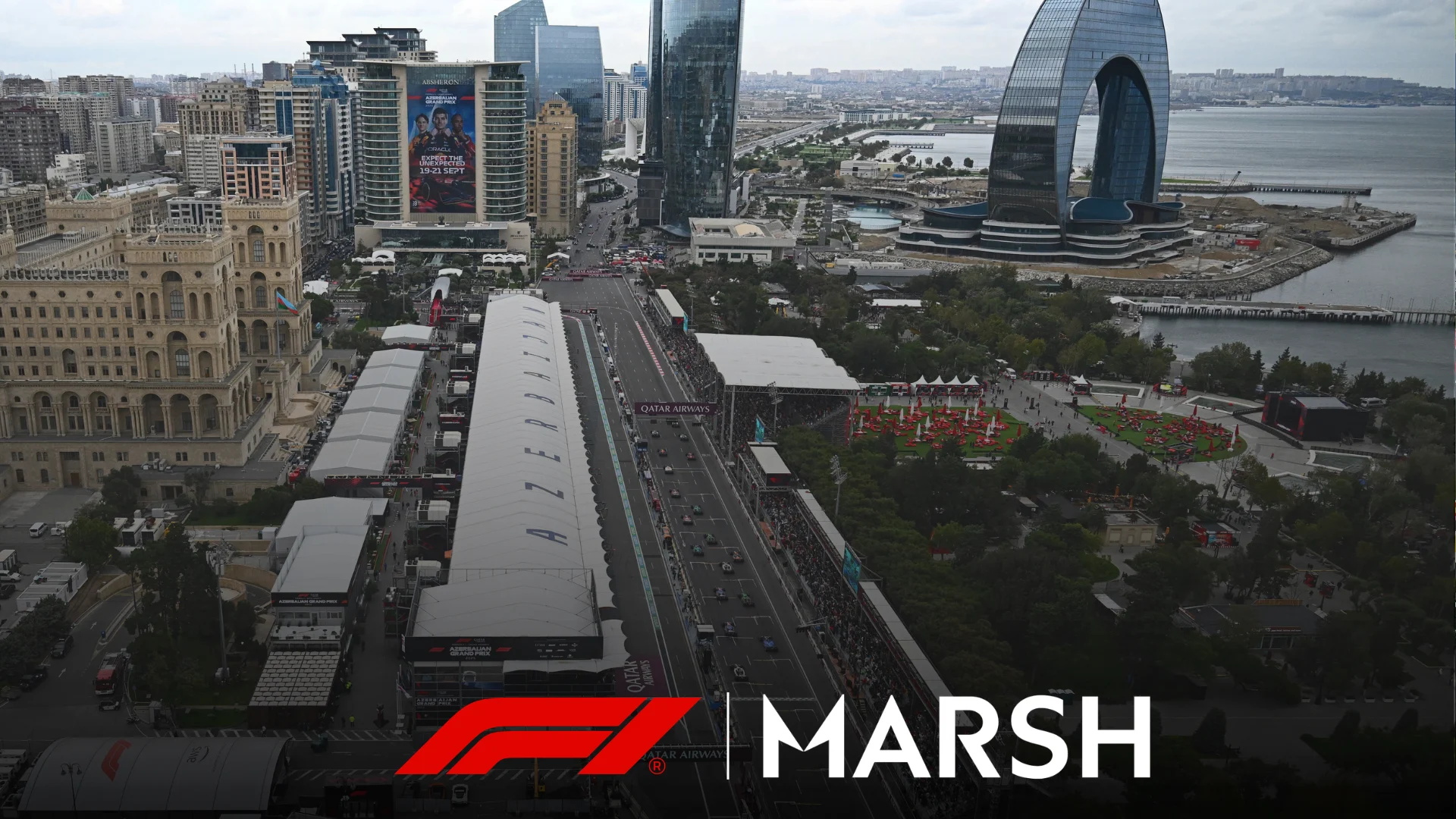
The layout has hybridised the traditional low-speed street race with the sort of low downforce, high-speed characteristics seen at Monza or Hockenheim. Miami and Las Vegas followed the template, but Baku got there first.
The ideal set-up dilemma
The main straight draws the eye but is misleading. It isn’t an ultra-low downforce blast; there is nuance and risk to manage. Qualifying and race demands differ sharply, leaving teams a real decision on downforce level.
Braking performance oscillates between extremes. The long straight means brakes are cold into the heavy braking zone of Turn 1. At other circuits that would prompt reducing airflow, but the rest of the lap is the opposite — a lot of braking points in rapid succession demanding plenty of cooling, and even more so in traffic. Race engineers pick the compromise that does the least harm.
Sector 2 and overtaking
Baku remains difficult to overtake, with anyone saving boost to use out of the final corner a tough proposition to pass. That gives the circuit a strong qualifying bias, and teams must think carefully about the twisting, lower-speed Sector 2 around the Citadel.
Time is gained or lost there, but setting up for qualifying speed needs more downforce, which makes the car vulnerable on the long straights in the Grand Prix. Active aero lessens the binary choice, but a choice remains.
The strategists’ perspective
McLaren Racing Director Randy Singh notes the historical qualifying bias:
Historically, Baku has been a strongly Qualifying-biased circuit as overtaking has tended to be challenging here, however, Oscar Piastri’s overtake for our first win in the 2024 Azerbaijan Grand Prix proved that it can be done.
Looking ahead to this year, Singh says overtakes have generally increased across the 2026 season compared to 2025. Combined with a stronger slipstream effect along Baku’s long main straight, that could create more passing opportunities and make the event slightly less qualifying-biased.
The new power units and deployment may make overtaking harder all else being equal, so assessment will be needed once on site.
In qualifying, the increased frequency of red and yellow flags places greater importance on banking a good lap time earlier. That makes it appealing to leave the garage earlier despite potential track improvement loss. Those flags also affect the race, pushing more cars toward extending long first stints with the hope of capitalising on interventions.
While one-stop races can sound simpler, they can increase pressure ahead of the first pit stop. With a wide stop window there can be several opportunities to pit, making the decision complex. Once the stop is made, fewer strategic levers remain, so timing heavily impacts the outcome.
The strategic masterstroke
An unimpeded Azerbaijan Grand Prix is typically a one-stop race, often assumed to be vanilla. Lando Norris’s reverse strategy in 2024 shows otherwise.
Norris qualified 16th after a yellow flag in Q1. McLaren started him on the hard compound with a view to running long, clearing cars, then a short final stint on medium with a strong tyre delta. The plan worked perfectly.
Norris made steady progress at the start, passing Ricciardo, Stroll and Nico Hulkenberg immediately, then Yuki Tsunoda and Ollie Bearman while medium starters pitted between Laps 10-17. That elevated him to P5 behind fellow hard-tyre starter Alex Albon.
Albon boxed on Lap 31, but Norris kept pushing. He was passed by Carlos Sainz and George Russell on fresher hards, but kept lapping quicker until he cleared the majority. Running P6, Norris stopped on Lap 37, losing only one place to Max Verstappen. He emerged 15s behind but used a tyre delta of around 1.5s on 25-lap-fresher mediums to close and pass Verstappen two laps from home, reclaiming P6 which became P4 after Sainz and Sergio Perez collided ahead. With Oscar Piastri winning, McLaren took the lead of the Constructors’ Championship for the first time since 2014.
Singh explained:
After the unfortunate yellow flag in Qualifying, which led to Lando getting knocked out in Q1, we chose to deviate from the conventional strategy and run an extended first stint with the aim to get back into the Race with the lead pack. Choosing the timing of the reverse strategy pitstop is a fine balance between having enough tyre delta on the cars you are racing to be able to overtake, while also reserving enough laps remaining to capitalise on the pace advantage and close the gap. In this case, Lando was able to exploit the pace of his medium tyres, which were 25 laps fresher, closing in on Verstappen and passing him before the end of the race.
The drivers’ perspective
2025 Formula 2 champion Leonardo Fornaroli, now McLaren’s reserve conducting FP1 sessions and simulator work, describes Baku as feeling like a street circuit despite very high speeds. There is no room for mistakes and the heavy braking makes locking the fronts easy.
The main straight is the longest on the F1 calendar because the last two official ‘turns’ are easy-flat in an F1 car. Good straight-line speed is vital, so cars run low downforce, but low and medium-speed corners still matter.
An interesting trait of Baku is grip evolution. Between the start of free practice and...