Michael McArdle says Northern Ireland Women can make World Cup history in Portugal playoff
McArdle backs Northern Ireland to chase first World Cup appearance
Northern Ireland Women manager Michael McArdle says his team are approaching Friday’s first-leg playoff against Portugal at Inver Park with belief they can make history, seven and a half years after leaving construction work to pursue coaching full-time.
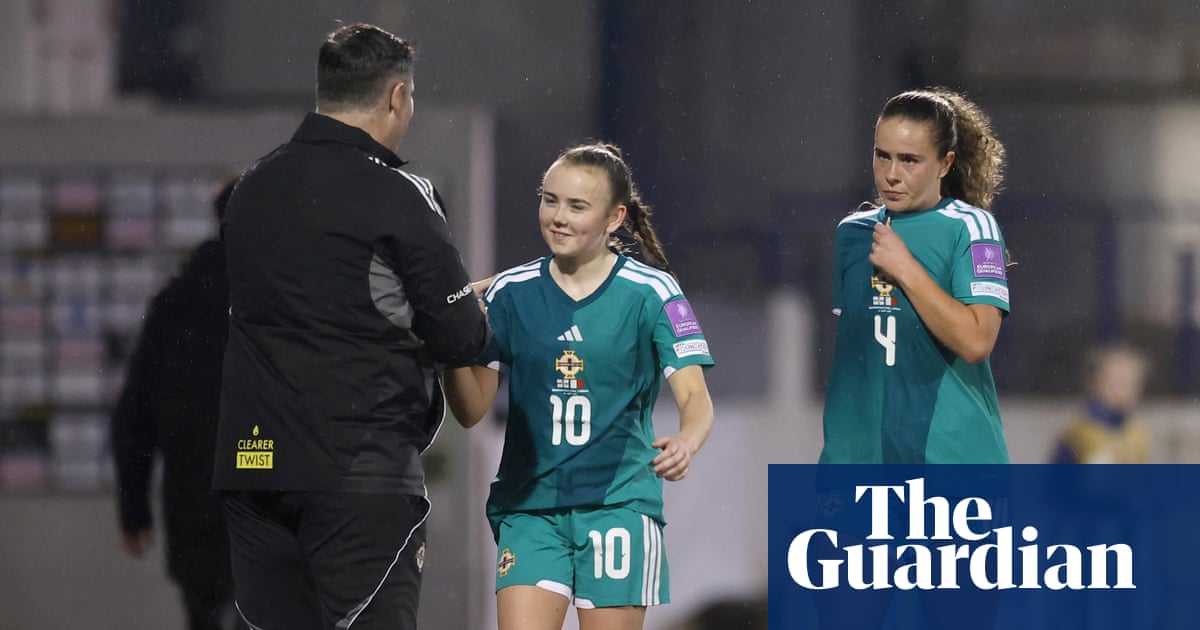
McArdle, 46, worked in construction while playing semi-professional football, studying for a degree in building services engineering and raising three young children with his wife Tammy before taking “probably a 300% drop in salary” to commit to coaching. The former goalkeeper laid foundations at Falkirk, St Mirren and Ayr United, coached Scotland Women’s Under-23s and served as Scottish FA head of elite women’s football before his March appointment by Northern Ireland.
He started with back-to-back victories against Malta in April to secure a place in the playoffs for the 2027 World Cup. The first-round tie with Portugal kicks off on Friday at Inver Park, with the return leg to follow.
“My wife is now a social carer in the village, looking after the old buddies that raised us – we’ve always been from families that give for others and I think coaching aligns with that easily, because ultimately that’s what coaching is,” McArdle told Moving the Goalposts. “I’m a servant leader. I’m very comfortable that way, as an experienced coach, being vulnerable and open. That servant leadership style, I wanted to make sure that the [Northern Ireland] players are aware of that right away.”
Flexible approach and ‘playoff ready’ mindset
Now a UEFA Pro licence holder influenced by videos of former Milan and Italy coach Arrigo Sacchi’s 4-4-2 drills, McArdle says Northern Ireland need flexibility.
“I deliberately didn’t go with one strict formation or style. For a nation such as ourselves, from a population perspective, we’re the 150th nation in the world and we’re sitting 50th [in the FIFA women’s world rankings] because we do punch above our weight for passion for the sport,” he said.
“We could easily just sit behind the ball and try to get through and finish with the most points in League B and then just go to the playoffs and sit behind the ball again and just try and stay in the game. For me, though, and for us as a nation, we’re trying to go: ‘Let’s take a step beyond this, let’s sustainably now move towards competing on a regular basis at a higher level.’
“To take that step, sometimes you need to take a step backwards and take a few hits as well. I wanted us to be exposed and embrace [being uncomfortable]. I kept referencing ‘playoff ready’, because ‘playoff ready’ is where we’ll be tested at the highest level. We learned so much about ourselves.”
McArdle pointed to his first four games in charge – April’s wins over Malta and June’s narrow 2-1 defeats by Switzerland and Turkey – as evidence of the learning process.
“The game of football is a living organism – you can’t predict what happens. We need to be ready for everything as a small nation. If we stick to one strict style of play, we won’t be adaptable when it comes to those moments.”
Path to Brazil
Northern Ireland reached Euro 2022 but have never played at a Women’s World Cup. McArdle is under no illusions about the scale of the challenge.
Should they overcome Portugal, either Croatia or Iceland would await in the second round of playoffs in December. If Northern Ireland progressed, they could still be the lowest-ranked of the eight European playoff winners. Only the seven highest-ranked of the eight round-two winners are guaranteed places in Brazil, meaning a further inter-confederation playoff in February would be required.
“There are six probably history-making results to go and get,” McArdle said. “Going toe-to-toe with Portugal is a great opportunity for us to test ourselves. When I first came into the post, I was very bullish to say ‘six points against Malta was a necessity’ and we had to put ourselves under that pressure – now the opportunity to do something special, that’s the piece we’re all excited about.”
McArdle said conversations with Irish FA senior figures Angela Platt, director of women’s football, Aaron Hughes, technical director, and former president Conrad Kirkwood helped convince him to take the role, with a bond between Glasgow and Belfast that “just felt like family”.