Verstappen wins rain-hit Bahrain Grand Prix in Malaysia as engine software glitch sparks F1 backlash
Race result and dramatic recovery
Red Bull’s Max Verstappen won his first race of the 2026 season in a dramatic, rain-affected Bahrain Grand Prix staged at Sepang International Circuit in Malaysia. The event marked Formula 1’s return to Malaysia after nine years, with the Bahrain round relocated to Sepang.
Kimi Antonelli finished second in the Mercedes and extended his championship lead to 84 points, while Ferrari’s Lewis Hamilton fought back from an incorrect tyre choice at the start to complete the podium in third. Hamilton dropped to 17th early on before his recovery drive.
Team-mate George Russell’s title hopes took a hit with a late engine failure that ended his race. The race was eventually run after a long stoppage caused by a software issue affecting the new power units.

Wet-weather start descends into chaos
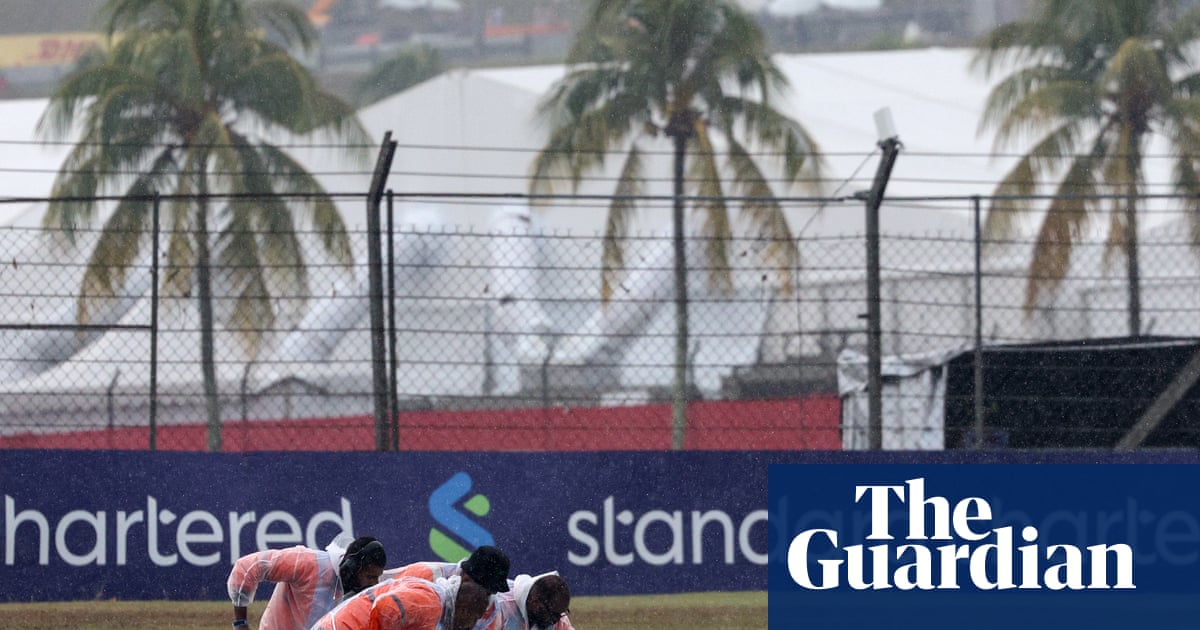
The Bahrain Grand Prix in Malaysia began in wet conditions but not at the original start time because visibility was considered too poor. Cars were sent out for formation laps on a still-wet track, then a bug in the wet-weather engine settings supplied by the FIA affected a number of cars, including those of Verstappen and Hamilton on the front row.
The formation laps had to be aborted and a new code written and supplied to teams to upload. The intervening period allowed the rain to ease, leaving the track pretty dry by the time the race finally got under way. It took a Safety Car on lap nine before drivers who started on intermediate tyres came in for slicks.
The Guardian described the opening as farcical. Engines’ software, now integral to power delivery in the almost 50/50 electrical-combustion power units, found itself in a scenario beyond its parameters. Verstappen announced he could no longer accelerate, Hamilton slowed and stopped before a forced reboot, and a Haas and a Cadillac also ground to a halt.
“These engines are so complicated and a lot of software is implemented,” Verstappen said. “When there is some kind of error or glitch, that’s the problem. I triggered it first, then I look in my mirror and I just see everyone … I was, like, wait, are they waiting for me?”
“It was like the Lego race,” Hamilton said. “Yeah, we had the same speed,” Verstappen replied, both drivers laughing at the absurdity.
The FIA said the problem was caused by a combination of low engine speeds, low grip and circuit layout coming up against wet-weather management of power-delivery software, which it described as an unanticipated bug. The delay lasted 53 minutes while the FIA wrote and applied a software update. The governing body said it will conduct a review with teams and power-unit manufacturers.
Reaction and context
BBC F1 correspondent Andrew Benson noted that the delay was not caused by conservatism about wet running. F1 has a collective agreement not to race when drivers can’t see where they are going, which applied at the original start time in Malaysia. He pointed to Brazil in 2024 as an example of a wet race run successfully, with Verstappen’s drive from 17th to victory.
On Hamilton’s claim he could have won had he started on intermediates, Benson said the truth will never be known because there was no direct comparison. When Verstappen switched to slicks, Hamilton’s tyres were much older, and once Hamilton passed Isack Hadjar there were only three laps to go, with Hamilton within 0.1s on one lap and 0.5s and 1.2s off on the others.
The Guardian argued the incident highlighted the foibles of the current engines and how much has been taken out of drivers’ control. It noted that drivers were reduced to pushing buttons on steering wheels, hostages to software over which they have no control, then deriding the situation afterwards. Carlos Sainz was quoted asking: “My only question is who, five years ago, decided this was the direction to go?”
Malaysia return and engine politics
Malaysia returned only because the Crown Prince of Bahrain was keen to stage his race and a deal was struck with the Malaysian government. The race was a success, with a record crowd of 261,000 this year, more than double the previous largest weekend attendance of 126,690.
Red Bull’s win was also the team’s first as a power-unit manufacturer. Red Bull Powertrains was set up for the 2026 regulations after Honda’s official withdrawal at the end of 2021. Ford is a key strategic partner, manufacturing some key engine elements and providing engineering support.
Team principal Laurent Mekies said: “Ford has been with us on this project since pretty much the very beginning. They are a key strategic partner for us on these operations. They are helping us on a number of topics. Specifically, to give you a few examples, they are manufacturing some of the key elements of the engines.”
The debate over engine regulations continued. Verstappen, Fernando Alonso and Lando Norris have expressed a view that F1 should return to naturally aspirated engines with no hybrid element. FIA president Mohammed Ben Sulayem has also pushed a return to naturally aspirated engines, citing sound and lighter cars, though such engines would use more fuel.
The next round is the Singapore Grand Prix at Marina Bay on 9-11 October, Formula 1’s original night race.