McLaren’s racing legacy hits the runway as 46 designers reimagine six decades of F1 history
McLaren’s history, redesigned
McLaren’s Technology Centre became a fashion runway on Wednesday as 46 MA fashion students from Central Saint Martins presented Designed to Race: Front Row, a 12-look collection inspired by more than six decades of McLaren’s Formula 1 history.
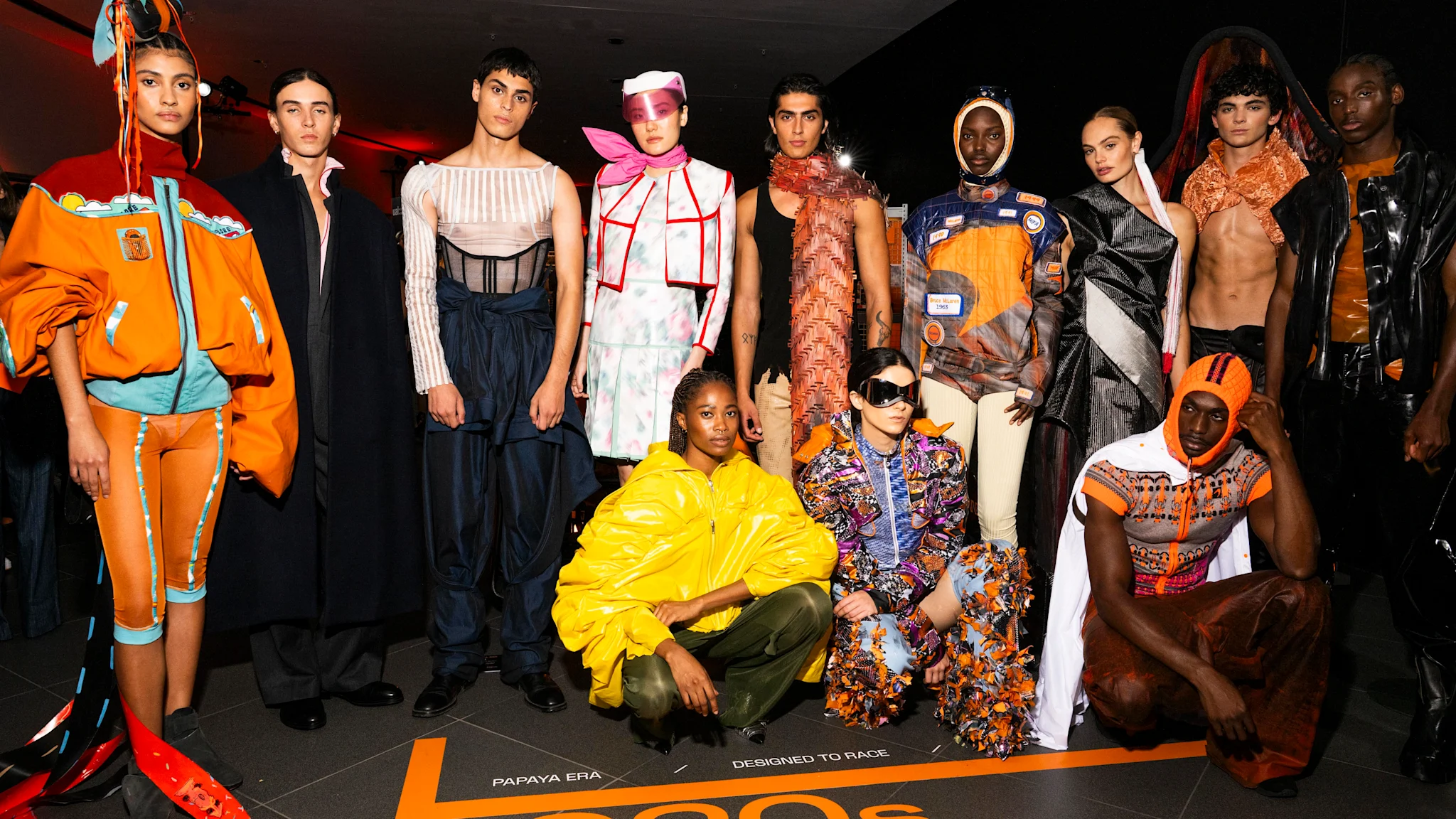
Models walked among some of McLaren’s most famous cars wearing designs that interpreted the team’s past and present rather than reproducing its racing apparel. The collection was organised into five chapters: Grit x Glamour, Precision and Power, Global Icon, Engineered Athlete and Papaya Era.
From Hunt’s style to Senna’s helmet
The opening section looked to the 1970s, when McLaren established itself as a leading Formula 1 team. Emerson Fittipaldi’s 1974 Drivers’ Championship and McLaren’s first Constructors’ Championship provided the historical backdrop, while James Hunt’s distinctive image supplied one of the collection’s clearest fashion references.
Flared silhouettes, leather, orange tones and distressed finishes echoed Hunt’s rebellious approach to racewear, including his habit of wearing his overalls tied around his waist. The designs borrowed from his attitude without simply recreating his wardrobe.
Later looks drew on Ayrton Senna’s famous yellow helmet, his precision behind the wheel and the physical idea of speed. Lightweight fabrics, airflow-inspired shapes and digitally developed patterns translated those themes into clothing. Other details reached beyond the drivers, incorporating track layouts, team graphics, racing equipment and the role of people such as female fire marshals.
Some references were deliberately hidden. Monaco’s famous hairpin, for example, was stitched inside a pair of trousers, rewarding a closer look at the garments.
Engineering meets fashion
The students were given a broad brief: a look could be inspired by a driver, a car, a period in McLaren’s history, the team’s engineering or the people around it. Enzo Keuning, one of the MA Fashion students, said the lack of a single prescribed interpretation made the project distinctive.
“There wasn’t one way to interpret that heritage,” Keuning said. “Each group brought a different perspective, from engineering and performance, to identity and craftsmanship, and we were challenged to transform those ideas into something new.”
That process resonated with McLaren’s own pursuit of marginal gains. Louise McEwen, McLaren Racing’s chief marketing officer, described both fashion and Formula 1 as high-performance disciplines built around craft, creativity and constant reinvention.
“We absolutely can’t stand still because we have to keep innovating to stay at the front of the grid,” McEwen said. “Even at the front, it boils down to microns and milliseconds that can make the difference between those grid positions for us.”
Engineering blueprints and aerodynamic forms informed the collection’s patterns and silhouettes. Carbon fibre, upcycled racing seatbelts, fabric offcuts, second-hand materials and used McLaren equipment were also incorporated into the looks.
The papaya era reaches the runway
The final chapter moved into McLaren’s current identity, where papaya colours, racewear, denim and knitwear reflected both the team and its growing fan culture. Daniel Ricciardo’s famous “Shoey” appeared as a headpiece, while another look explored the perspective of young supporters who see drivers as heroes.
Toy cars, childlike drawings and a cape-like silhouette formed part of that fan-focused design. Used McLaren racing boots from earlier eras were also brought back into the finished look, linking the present-day audience to the team’s past.
For McLaren, the project was less about producing merchandise than opening a dialogue between Formula 1 and fashion. The collaboration developed over roughly nine months and highlighted parallels between the two fields: experimentation, craftsmanship, precision and the willingness to learn through trial and error.
As Central Saint Martins course leader Fabio Piras noted, the runway performance was only the visible conclusion of months of revisions, criticism and mistakes. The result was a collection that treated McLaren’s history not as a museum piece, but as material to be reinterpreted for a new generation.