Uttar Pradesh Breaks Into India's Export Top Tier as Merchandise Exports Touch Rs 1.72 Lakh Crore
Uttar Pradesh has steadily strengthened its position in India's export economy during the tenure of the Yogi Adityanath government, with the transformation visible not only in rising export value but also in a widening exporter base, expanding district-level participation, new product categories and infrastructure built to connect local manufacturing clusters with international markets.
The scale of the change is reflected in national assessments. The NITI Aayog Export Preparedness Index 2024 placed Uttar Pradesh fourth among large states with a score of 62.09, identifying it as a "Leader" state under the index framework. The report recorded merchandise exports of about Rs 1.72 lakh crore in FY2024 and named electronics, leather and footwear, agriculture and food processing, and textiles and apparel among the state's core export sectors.
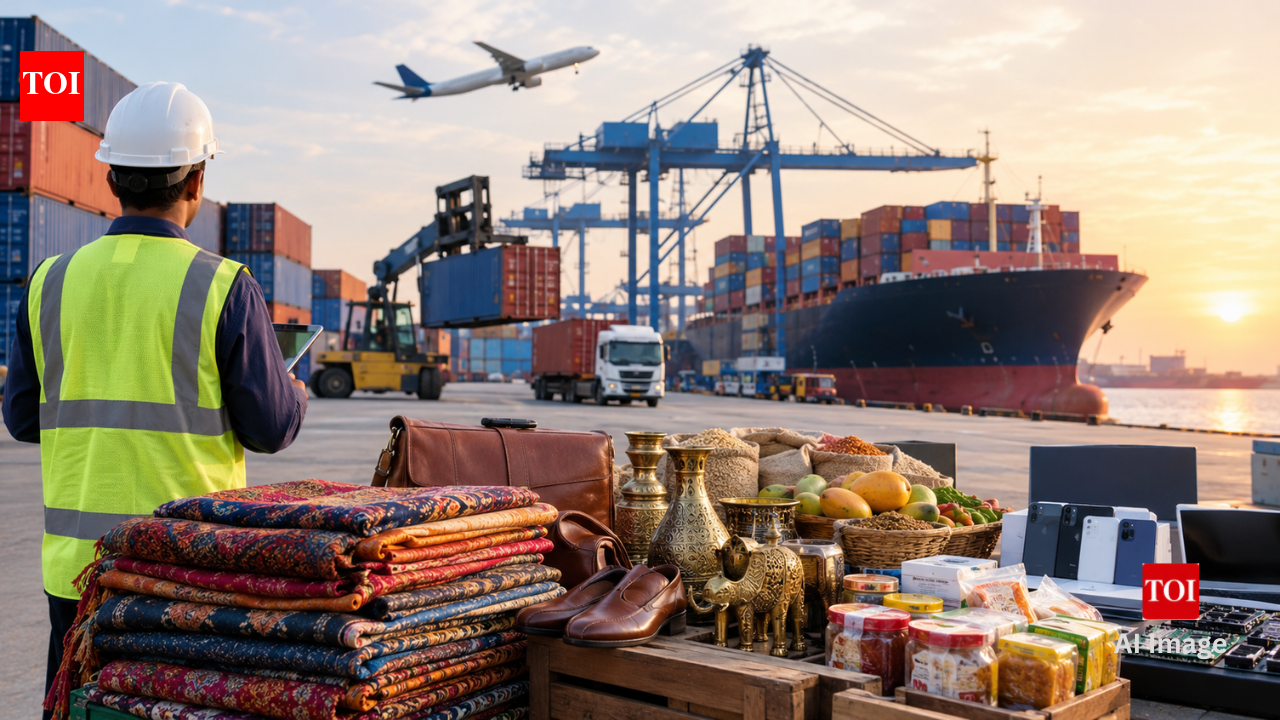
Uttar Pradesh's export journey has consequently moved beyond a handful of traditional clusters. Noida-Greater Noida's electronics ecosystem, Moradabad's metalware, Bhadohi's carpets, Agra's leather products, Varanasi's textiles, Kanpur's leather and engineering products, Lucknow's emerging pharmaceuticals and medical devices, and the state's agricultural and processed-food products are increasingly part of a wider export ecosystem.
From traditional clusters to an export-oriented economy
When the Yogi government took office in 2017, Uttar Pradesh already possessed a substantial industrial and handicraft base. The challenge was to connect these local strengths more effectively with national and international markets.
One of the most visible interventions was the One District One Product (ODOP) programme, launched in January 2018. The objective was to identify the distinctive product associated with each district, strengthen production and skills around it, improve packaging and branding, facilitate finance and create market access.
According to Invest UP, ODOP had by 2024 become an important component of the state's export ecosystem, with ODOP products accounting for about half of the state's reported exports in that year. Invest UP states that ODOP-related exports amounted to approximately Rs 93,000 crore out of Rs 1.86 lakh crore in exports.
This approach effectively linked export promotion with district-level economic development. Instead of treating exports purely as the domain of large factories, the policy framework increasingly brought artisans, MSMEs, food processors, handicraft producers and small manufacturers into the export chain — an effort to take products from the district to the domestic market and from the domestic market to the world.
Export value reaches a new scale
Official Government of India data underline the expansion of Uttar Pradesh's merchandise exports over the longer term. A ministry of commerce state-wise series shows Uttar Pradesh exports rising from about US$26.58 billion in 2020-21 to US$51.14 billion in 2024-25, although year-to-year comparisons are affected by global trade conditions and commodity prices.
The state's own Export Promotion Policy 2025-30 places the combined goods-and-services export base at around US$21 billion for FY2024 under its policy definition and sets a target of US$50 billion by 2030. The policy focuses on increasing the exporter base, encouraging MSMEs and first-time exporters, improving infrastructure and expanding the state's participation in international markets.
These figures come from different statistical and policy frameworks and therefore should not be treated as directly interchangeable. Together, however, they indicate the scale of the state's export ambitions and the importance the government has attached to exports as a driver of economic growth.
A new policy architecture for exporters
The export transformation has been supported by successive policy measures. The UP Export Promotion Policy 2020-25 sought to establish the state as a major export hub through infrastructure development, capacity building and institutional support. It included measures such as a single-window mechanism, a dedicated GST cell for exporters, support for GI products and a B2B exchange intended to facilitate online trade by smaller enterprises.
The newer Export Promotion Policy 2025-30 carries this approach further. It proposes increasing exports from the policy's FY2024 base of US$21 billion to US$50 billion by 2030. It also seeks a 50 per cent increase in registered exporters, with particular emphasis on MSMEs, startups, ODOP units and first-time exporters. The policy also places emphasis on export-oriented infrastructure, logistics, testing, certification, market development and fulfilment capabilities.
Exporters are to receive support for areas such as international certifications, trade fairs, digital marketing, export credit insurance and e-commerce. This represents an important change in approach: export growth is increasingly being viewed not simply as a matter of production capacity, but as an ecosystem involving quality, certification, finance, branding, logistics, digital commerce and international market intelligence.
A diverse product basket
Uttar Pradesh's export basket is unusually diverse. NITI Aayog's 2024 assessment identifies electronics, leather and footwear, agriculture and food processing, and textiles and apparel as core sectors. It also identifies defence and aerospace, renewable-energy equipment, organic food products and medical devices as emerging areas. The diversity provides a degree of resilience because the state's export performance is not dependent on a single industry.
The traditional export clusters remain important. Moradabad's brass and metalware, Bhadohi's carpets, Agra's leather products, Varanasi's textiles and handicrafts, Kannauj's perfumes and numerous agricultural products continue to connect local production with international consumers.
Electronics adds a new dimension
Perhaps the most significant structural change has been the emergence of electronics as an export-oriented industry. Noida and Greater Noida have attracted major investments in mobile-phone and electronics manufacturing, creating supply chains involving components, assembly, packaging, logistics and related services. NITI Aayog notes that the corridor contributes around half of India's mobile-phone production and contains electronics manufacturing infrastructure and SEZs. The agency also identifies electronics as one of the state's principal export strengths.
The growth of electronics also demonstrates how industrial policy can change the composition of exports. Products associated traditionally with Uttar Pradesh, such as handicrafts, carpets, leather and textiles, continue to have global markets, but they are increasingly accompanied by high-volume manufactured products. The next stage could involve greater participation in electronics components, semiconductor-related manufacturing, engineering products, artificial intelligence and technology-enabled services.
Agriculture moves closer to global markets
Agriculture remains another major pillar of the export economy. Uttar Pradesh has a large production base in sugarcane, cereals, fruits, vegetables and other agricultural commodities. The state government's agriculture export framework has sought to build clusters, improve post-harvest handling, establish export facilitation centres, strengthen packaging and encourage international buyer-seller interactions.
Taken together, the state's export story increasingly combines traditional craftsmanship with modern manufacturing — an ecosystem that now spans artisans and MSMEs alongside large-scale electronics production, with policy aimed at pushing the state from local strengths to global markets.