Kent volunteers unearth Roman villa with rare hypocaust near Trosley after Google Earth tip-off
From satellite to soil
The Kent Archaeological Society runs the ongoing Trosley Heritage Project, described by Current Archaeology as a larger landscape project studying how Trosley has been inhabited over time. Part of the detective work happens at the desk, with members combing publicly available satellite imagery for signs of buried features.
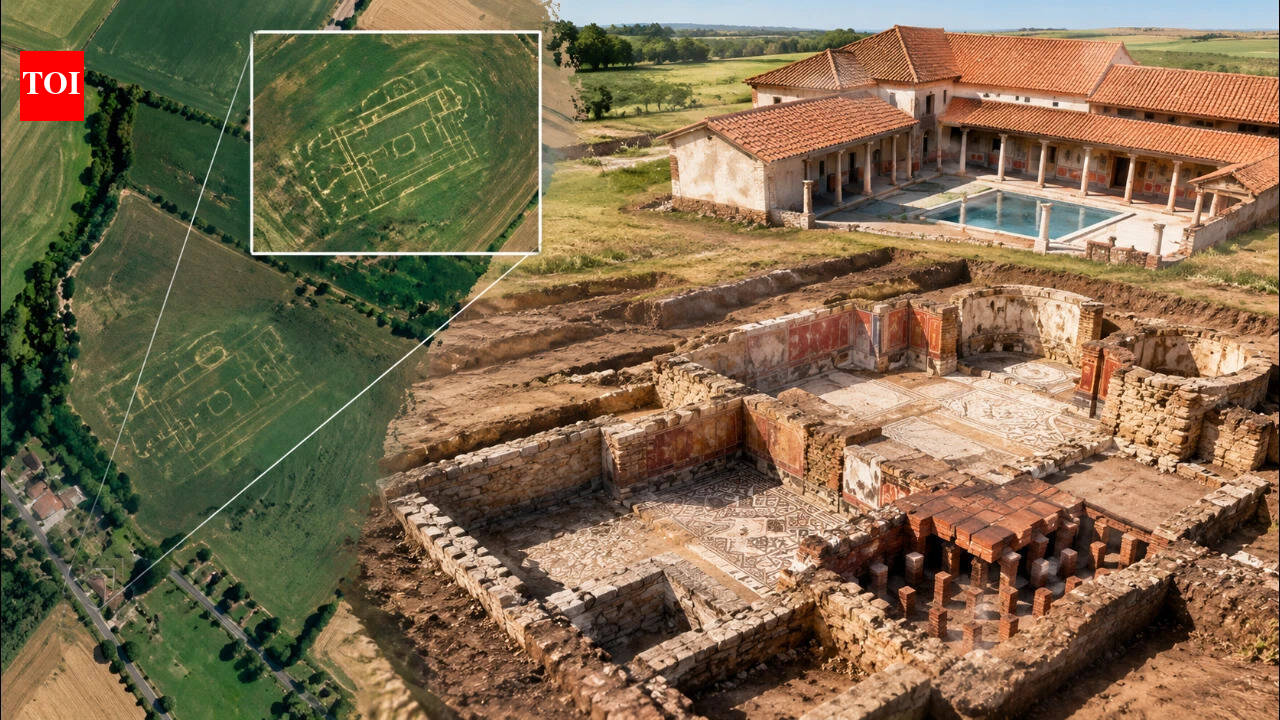
Because crops grow differently above buried walls and ditches, they leave “crop marks” visible from the air even when nothing shows at ground level. Volunteers noticed a distinctive pattern in farmland near the village. The Society’s own report, “Roman villa with bathhouse and hypocaust system revealed near Trosley,” written by Jacob Scott, appeared in issue 119 (Winter 2022) of the Kent Archaeological Society magazine, describing how crop markings were spotted on Google Earth after a particularly dry period — which led to fieldwalking and test pits in the year before excavation. Cropmark projections created by Chris Blair-Myers were then used for trench placement.
Current Archaeology, as reported by The Past, says the Society first found the site in 2010 during a survey of Google Earth images, while the 2007 date given by the heritage record refers to the imagery that revealed the cropmarks. The Kent Historic Environment Record entry, “Possible Romano-British building, Trottiscliffe,” describes a faint cropmark visible in Google Earth images from 2007 and aerial photographs from 2008: two squares connected by a rectangle, about 28 metres long but no more than 14 metres wide.
The same record notes that roof tiles, box flue tiles, fragments of painted plaster and coins from the 3rd and 4th centuries were found in a field north of Trottiscliffe, and that fieldwalking turned up Roman roofing tile, pottery and mortared rubble suggesting a buried masonry structure — perhaps a villa.
The September 2022 community dig
More than 50 volunteers assisted with the September 2022 excavation, directed by site director Richard Taylor, according to The Past’s write-up of issue 394 of Current Archaeology. It was, for many of them, a first dig. “For many volunteers, it was a first excavation,” Taylor told Artnet News, adding that most archaeology in Kent is developer-led, which makes openings for volunteers uncommon.
Trench 1, dug over the main building, revealed foundations of the villa made of local ragstone and flint. Third- and fourth-century ceramics found at the site include local coarse wares, Oxfordshire wares and some Samian wares, alongside several coins dating to the 4th century. A quantity of multicoloured painted wall plaster from Trench 1 likely adorned the villa’s interior walls. Archaeology magazine also lists a fourth-century copper-alloy strap-end shaped like an amphora, a small Romano-British key and two fourth-century coins.
A rare surviving hypocaust
Other trenches uncovered the foundations of a bathhouse and a pilae stack — an upright stack of tiles that supported the floor above the heating room. The Past describes how it had risen to at least 11 tiles, though the bottom tile remains to be excavated. At some point, possibly during the 4th century, the bathhouse appears to have been filled in and converted into another structure. A metalled surface of compacted flints was found west of the bathhouse.
Taylor said in a statement reported by Artnet News that “among the hundreds of villas across Kent, a surviving hypocaust is rare.” Archaeology magazine includes his assertion that running the hypocaust was costly because it needed an uninterrupted supply of wood fuel and a labour force to run it.
Wealth, trade and a return in 2023
Taylor told Artnet News the occupants probably farmed the surrounding land and sold their crops in London, Canterbury or Gaul. The Society’s magazine report said it planned to return in September 2023 to investigate the bathhouse further, and the Society’s later page on the site states that its 2023 excavations at Trosley Court revealed a Romano-British bathhouse.