Director Christin Freitag on bringing Michael Schumacher’s 1994 title season to life in Netflix documentary
Netflix’s Schumacher ’94 aims to put viewers inside 1994
Released on Netflix on October 2, Schumacher ’94 – The Birth of a Legend follows the then 25-year-old Benetton driver from his opening victory in Brazil to the title decider in Adelaide.
The documentary features interviews with his wife Corinna, former Benetton Team Principal Flavio Briatore, Bernie Ecclestone, David Coulthard and his manager Willi Weber, among others.
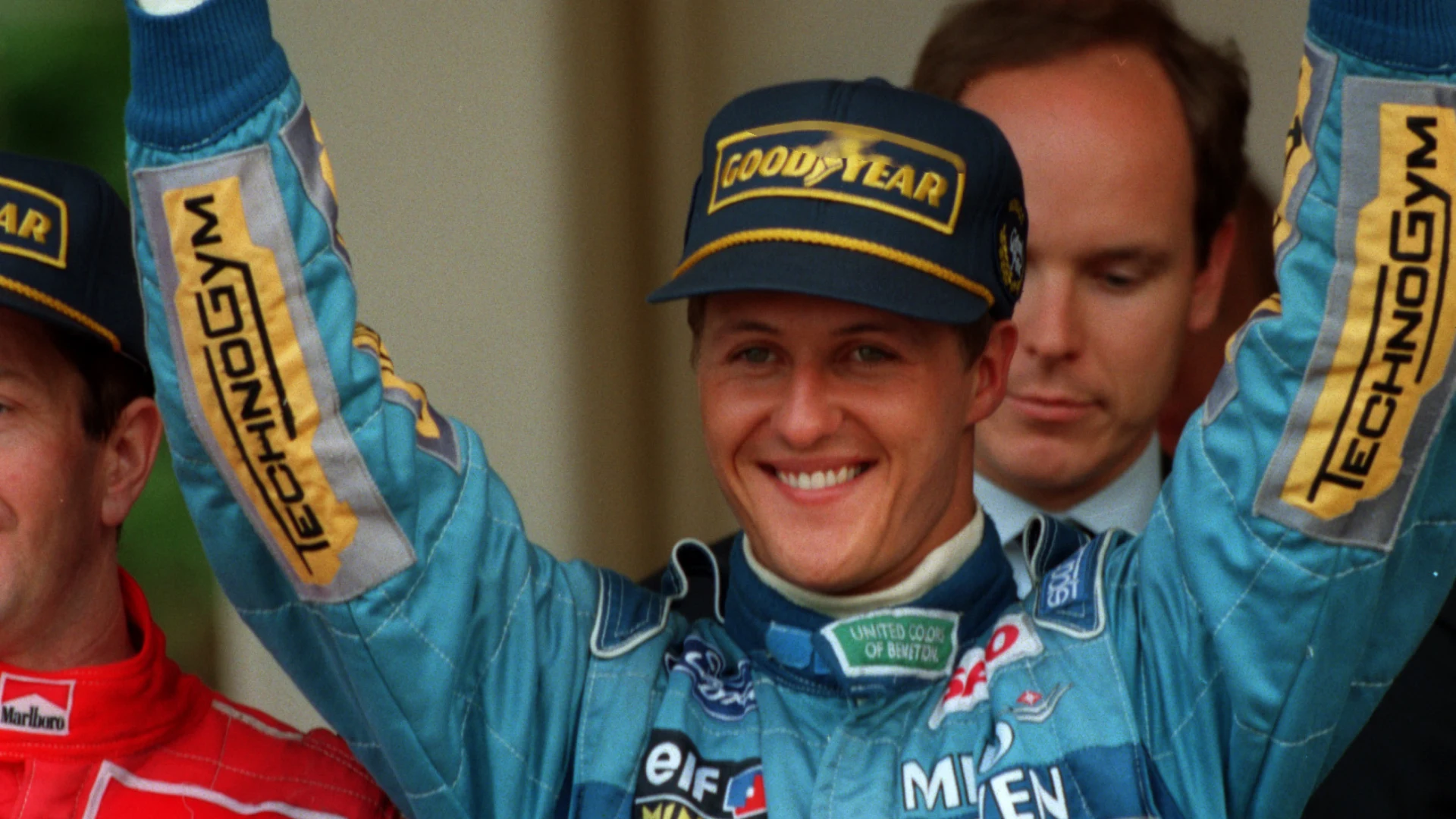
Director Christin Freitag said the aim was not to look back from the outside but to transport the audience into the time.
"That’s what we were trying to accomplish – you don’t look from the outside or look back, but you really transport yourself into the time, into this extreme season of Formula 1, and be right there with him," Freitag tells F1.com.
1,300 hours of archive
Freitag and editor Bobby Good scanned roughly 1,300 hours of footage from the races, looking for less familiar moments alongside the major races.
"When you’re new to a subject, you don’t know what you don’t know, so there’s always the possibility of finding interesting stuff," she explains. "We had a structure, but we scanned everything. I think we had 1,300 hours of footage from the races and my editor, Bobby Good, was relentless in searching through everything."
Freitag planned for interviewees to recount events in the present tense, placing memories alongside archive, and wrote a script that determined scene order, protagonists and narrative links.
"I knew I needed a lot of archive footage for it to be immersive, so I thought maybe 60 or 70 per cent should be archive footage," she says. "I essentially wrote a script. I knew which scene came when, what protagonists I needed for each scene, and what led to what. It’s basically film-making construction."
One early image that stayed with her was an interview with a spectator at Hockenheim. Asked by a television reporter whether the noise was too much, the man in glasses replied: "No, not at all. Wonderful, wonderful." The moment captures growing enthusiasm for Schumacher in Germany during his first championship season.
Sound of the 1990s
The soundtrack combines original scoring with music from the decade, including Pulp’s Common People and Paula Abdul’s Rush Rush, a song that holds particular significance for Michael and Corinna.
"It’s important to have songs that transport you right into the time, but the editing is so precise to the music that it was necessary to score a lot of things," Freitag explains.
"With the score, it was also a process of finding the right tone. You want to feel like you’re in the ’90s, but you don’t want everything to be the same. It has to be modernised in a way that transports you back, but makes it better in a way."
The decision to include Common People, released in 1995, towards the start of the documentary was a gut feeling.
"I just loved the song," Freitag laughs. "We had a collection of ’90s songs, and a lot of ’90s songs really hurt my ears! It was a gut feeling, more or less. That it also fit was a bonus."
Revisiting Imola
The 1994 San Marino Grand Prix remains one of the darkest weekends in Formula 1 history. After Rubens Barrichello suffered a serious crash in Friday qualifying, the sport was shaken by the deaths of Roland Ratzenberger during Saturday qualifying and three-time champion Ayrton Senna during Sunday’s race.
Freitag wanted to take viewers through the weekend as people lived it.
"I wanted to make something that takes you through the weekend as everybody back then lived through it. You come into it totally unprepared, quite light-hearted in a way. The mood is good. You’re going into a race weekend in Italy. It’s going to be a very exciting race. And then it happens out of nowhere. Then something happens again, and again."
Even after shortening the Imola footage, difficult editing choices remained.
"You’re in the middle of it and can’t believe it’s happening, that it’s not stopping, and that it’s getting worse and worse," she says. "I wanted to recreate that experience of being in the weekend, reliving this trauma."
Senna features later in the documentary, with the link between the great Brazilian and the German extending far beyond that tragic weekend. In 2000, Schumacher became emotional at Monza when asked about equalling Senna’s total of 41 Grand Prix victories.
"I wanted [Senna] to still be there because I feel he’s always there with Michael, always at the back of his mind," Freitag explains. "He carried it with him all those years, so I knew it was very central to him."
A different Schumacher
For Freitag, the research revealed a more sensitive side to the seven-time champion.
"I was surprised by the person I found, because growing up I knew him much later, in the 2000s, when he was already the legend. I was surprised that he comes across as quite sensitive. You feel the way he’s protecting this sensitivity, and you can also see where he puts on a show, or where this diverges and he becomes somebody else."
In one archived English-language interview, Schumacher discusses his fears after Imola, giving Freitag access to his own account of the season.
"When I was interviewing all the other people, I was searching for this specific character trait, because I had always thought he was so fearless, so ruthless. But in the archive, especially in this interview, I see a totally different Michael. I was searching for this guy. Is that the real one? Does he have a protective shield, or is that just one moment in time? That formed my picture of him, my feelings towards him, a lot. I centred the film around it."
Willi Weber, who managed Schumacher during his rise through F1, supported the picture. Freitag notes that most protagonists solidified the image of Michael as someone without fear and very straightforward – except Weber, who was very close to him.
"He solidified what I’d seen in the archive. He said Michael was totally different after Imola, that it really changed him."
Corinna Betsch, Michael’s girlfriend in 1994, is a central figure. The couple married the following year, and the documentary includes her memories of their early relationship and entering the F1 world together.
"I also like that they came into this circus as a couple, both very fresh, and discovered it together. I like the way she wasn’t impressed by it at all. She found it rather boring, and then developed an interest in it."
Freitag met Corinna through the production company to discuss the documentary before filming their interview.
"She was so light-hearted and fun. That jumped out at me. She had such a lightness about her, and I wanted to bring that across in the film because I hadn’t seen it in previous interviews."